Six Clues in a Bus Shelter: A High Street Character Reference
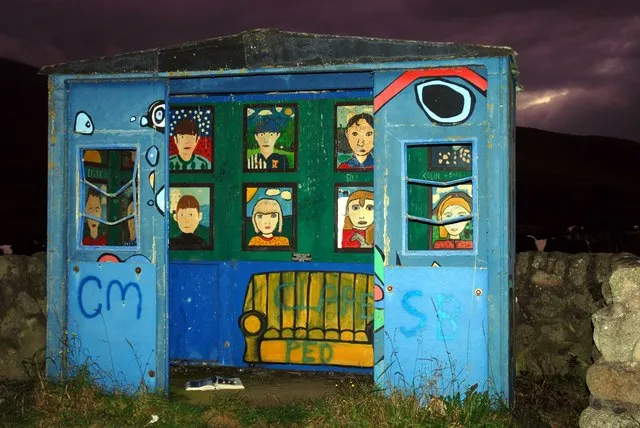
Photo: Debbie Turner, CC BY-SA 2.0, via Wikimedia Commons
If you want to know a town, skip the welcome sign. Avoid the heritage plaque. Do not bother with the leaflet rack in the library, assuming the library is still open. Go and sit in the bus shelter for twenty minutes. Not because you are waiting for a bus. Because you are reading the place.
The British bus shelter is a tiny museum of civic life. It is free, open all hours and almost entirely uncurated. Nobody has decided what belongs in it. That is exactly why it is useful. Here are six things it will tell you before the 08:14 has even failed to arrive.
1. The advert that refuses to move
Every shelter has an advert, and every advert has been there longer than anyone intended. It might be for a gym, a solicitor, a double-glazing firm or a carvery. The paper is faded, the corners are peeling, and the phone number looks like it belongs to a different decade.
A shelter advert is a small lesson in local economics. It tells you who can afford to advertise, who owns the shelter, and how long it has been since anyone gave it a proper clean. If the poster is for a festival that no longer runs, the town has a longer memory than maintenance budget. If it is for a takeaway that closed years ago, the shelter has become accidental archaeology.
The best ones are slightly too optimistic. 'Book your Christmas party now' in March. 'New menu' in a font that has not been new since the first mobile phone. The bus shelter does not judge. It just holds on to things.
2. The handwritten notices
Look past the glass and you will find the real local newspaper. It is made of A4 paper, laminated at home, and held up with Sellotape that has gone brown at the edges. Lost cat. Yoga in the village hall. Piano lessons. A plea about dog fouling. A notice for a coffee morning that happened last Tuesday.
These notices tell you who cares enough to print something out. They tell you what the town is worried about, what it is selling, and what it is trying to organise. They also tell you about the local font situation, which is usually Comic Sans, sometimes Times New Roman, and occasionally something wild like Calibri.
A handwritten notice is a tiny act of faith. Someone believed that a stranger would read it, and that the stranger might do something about it. That is not nothing. That is a town trying to talk to itself.
3. The seating hierarchy
A bus shelter bench has an unspoken hierarchy. The dry end is premium. The middle is for the confident. The end nearest the road is for the person who wants to be seen to be waiting. The leaning spot by the glass is for teenagers, or anyone who has decided that sitting is a sign of weakness.
Watch for a few minutes and you will see the rules. Older residents take the dry end. School kids claim the back. Someone stands rather than sit because the bench is slightly wet, or because they are only going one stop, or because they have decided that the shelter is a stage and they are not ready to sit down yet.
If the bench has been removed, that tells you something too. If it has anti-sleep bars, that tells you something less pleasant. A shelter with no bench is just a posh umbrella. A shelter with a bench and a bin is a small act of civilisation.
4. The archaeology of crisp packets
The floor is a layer cake of local life. A bus ticket. A receipt. An energy drink can. A crisp packet that has been there so long it has become part of the streetscape. Cheese and onion, usually. It is always cheese and onion.
You can read the strata. Fresh litter means the shelter is used. Old litter means it is used but not cleaned. No litter at all means either a very diligent council or a shelter nobody bothers with. Both are useful facts.
The bin is the tell. An overflowing bin is a town under pressure. An empty bin is either efficiency or indifference. A bin that has been taped shut is a story in itself, and not a happy one.
5. The timetable's optimism
The timetable is the shelter's official fiction. It says the bus will come at 07:42, 08:12 and 08:42. It says this with the straight face of a laminated promise. The bus, meanwhile, has its own ideas.
A printed timetable tells you the town still believes in paper. A digital display tells you someone has invested. A handwritten 'temporary timetable' notice from several months ago tells you the town is resilient, or forgetful, or both. The 08:14 is not a bus. It is a rumour.
But there is something quite lovely about the optimism of a timetable. It is a small public statement that things will keep running. The bus may be late. The shelter still stands. The sign still says what it says. There is comfort in that, even when you are freezing.
6. The weather station and social club
The bus shelter is also a weather station. The bench is wet on one side. The wind comes through the gap by the glass. The floor has a small puddle that has been there since Thursday. You do not need an app to know which way the rain is coming from.
And it is a social club without walls. Pensioners, school kids, someone eating chips, someone on the phone, someone who has clearly missed the bus and is now pretending they meant to stand there. The shelter is a living room for people who are just passing through.
So next time you are waiting, look around. The adverts, the notices, the bench, the bin, the timetable, the crisp packet: they are all part of the town's character reference. The bus shelter does not shout about local identity. It just leaves the evidence lying around.