Hold Your Tray Like You Mean It: Field Notes from the Sunday Carvery
It is 1.20pm on a Sunday in November, and the daylight outside has already handed in its notice. Inside the pub, a queue is forming with the quiet solemnity of a parish council meeting. Someone at the back sighs. Someone at the front pretends not to hear. A child holds a tray like a shield. This is the Sunday carvery, and before a single roast potato is lifted, we are all taking part in something that looks a lot like democracy — if democracy involved a ladle and a mild sense of panic about Yorkshire puddings.
I have queued in a function room with a carpet that smelled faintly of gravy and history. I have queued beside a man in a regatta fleece who explained, unprompted, that the trick was to "get in early for the crackling". I have queued behind a toddler allowed to carry the Yorkshire pudding on a side plate, treating it like a holy relic. Every time, I have come away with the same thought: for a country that claims to be reserved, we do an awful lot of silent negotiating when there is meat and gravy involved.
The constitution of the tray
The tray is your ballot paper. Hold it with both hands, at chest height, and never let it drift towards the person in front. Too low looks defeated. Too high looks like you're about to make a speech. The correct grip is somewhere between "I am a capable adult" and "please don't let me drop the mint sauce".
Then there is cutlery. You pick it up at the start, usually from a basket, and carry it like a relay baton. There's always one person who forgets and doubles back, muttering apologies, and always one who has brought their own — a quiet maverick who has clearly been burned before. The queue itself is a series of small agreements. You leave a gap. You don't crowd. You don't lean over to inspect the cauliflower cheese until it is your turn. You do, however, crane your neck slightly, because everyone wants to know how many roast potatoes are left. This is not greed. It is risk management.
Ladle law and the quiet authority of the server
At the front stands the server. They hold the ladle like a conductor's baton and have more power than anyone else in the room. They decide the pace. They decide the portion. They decide whether your "just a little bit" is a true little bit or a ladle that arrives with the momentum of a small tide.
The questions are ritual: "Beef or turkey?" "Both?" "Yorkshire?" "Gravy?" There is a pause before the gravy that lasts a fraction longer than it should, and in that pause the whole queue holds its breath. "Just a splash," you say, and the server nods, and you both know a splash is a flexible concept. The experienced carvery-goer does not ask for more. They look at the plate, then at the server, then back at the plate, with an expression that says "I trust you". It works about half the time.
The roast potato question
Here is the thing nobody tells you: the roast potatoes are the real test of character. Not the meat. Not the gravy. The potatoes.
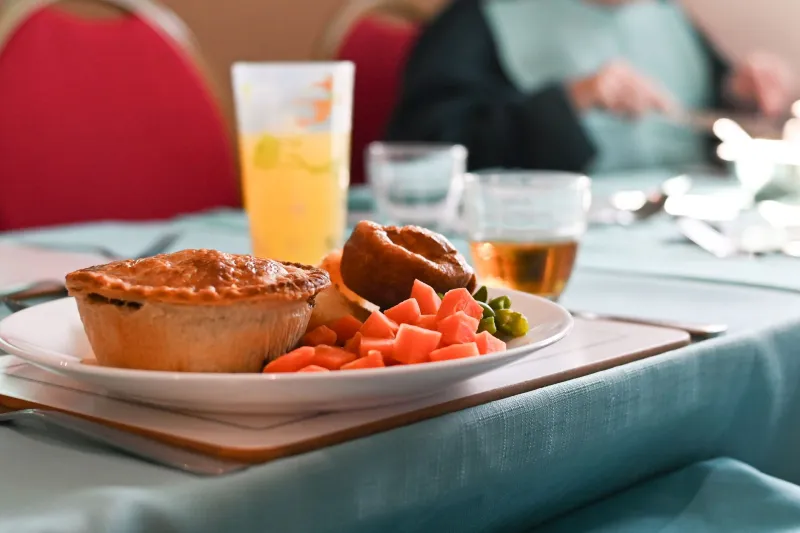
How many is acceptable? Four is bold. Three is safe. Two is either modest or a tactical decision ahead of pudding. One is an act of self-denial the rest of the queue will quietly respect but not understand. And there is always someone — usually a man in a golf jumper — who takes six and says "I'll come back for more" with the confidence of a man who has never been judged in his life. The child's plate is a separate economy. Children are allowed three Yorkshire puddings and no vegetables, and nobody says a word, because the carvery is fundamentally a kind place. It understands that a small person with a big plate is not a problem to be solved. It is the whole point.
Gravy: a negotiation in three parts
First comes the request. "Just a bit." Second comes the pour. Third comes the moment where you decide whether to say "stop" or let it ride. Most of us let it ride. Gravy is not a condiment at a carvery. It is a commitment.
The gravy boat is a lovely idea, but it is also a lie. You will not go back for more. The queue is too long, the table is too far, and your Yorkshire pudding is already going soft. So you take what you are given, and you are grateful, and you spend the rest of the meal eyeing the next table's jug with a quiet, dignified envy.
Vegetables, and the cauliflower cheese exception
The vegetables are where the carvery gets interesting. Carrots, peas, cabbage, sometimes swede. You take a spoonful of each because it seems rude not to, and because your mother's voice is still in your head somewhere. But cauliflower cheese is different. It is the carvery's premium product, and there is never quite enough. If someone ahead of you takes a generous scoop, you feel a small, irrational resentment. If you are the one taking it, you feel a brief flash of power. Then there's mint sauce, which exists in its own universe, and horseradish, which is either a dare or a mistake.
The democracy of the table
Once the queue breaks up, you sit. Tables are close together. You might be next to a family with a birthday, or a couple who have clearly been coming here since the 1980s, or a man eating alone with a newspaper and a pint. Nobody minds. The carvery doesn't do exclusivity. It does paper napkins and slightly wobbly tables and a shared understanding that we're all here for the same reason: a hot meal, a bit of crackling, and the chance to pretend we're not counting the potatoes.
And when it's over, you sit back and feel something close to contentment. The plate is a battlefield of gravy and crumbs. The Yorkshire pudding has done its job. The queue is already forming again for the next sitting, and somewhere at the back, someone is holding their tray like they mean it. That's the thing about the carvery queue. It's not really about the food, though the food matters. It's about the fact that for twenty minutes on a Sunday, we all agree to wait our turn, hold our trays, and trust the person with the ladle. That's not a small thing. That's Britain, on a plate. Maybe that's why the Yorkshire puddings seem to be watching. They know.