The 10:05 Mince Pie and Other Rules of the Village Hall Christmas Fair
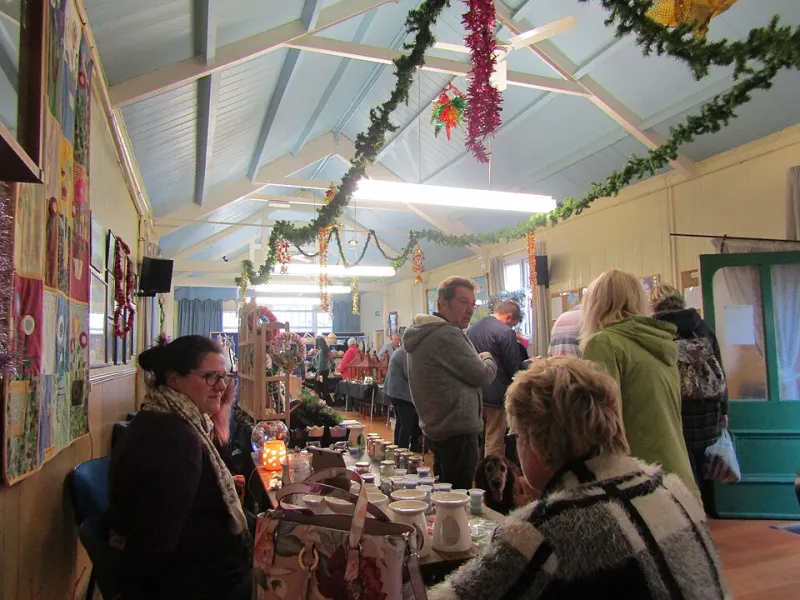
Photo: Kolforn (Kolforn) I'd appreciate if you could mail me ([email protected]) if you want to use this picture out of the Wikimedia project scope. This file is licensed under the Creative Commons Attribution-Share Alike 4.0 International license. Yo
There is a particular smell to a village hall Christmas fair. It is part floor polish, part tinsel, part hot pastry and part the faintly electrical warmth of a tea urn that has been switched on since 8:40am. You notice it before you are fully through the door. By then someone has already said “ooh, you made it” in a way that suggests your attendance has been noted in a small book somewhere. It probably has.
I went along to one last weekend, as you do in November, and came away with a jar of marmalade, two raffle tickets and a vague sense that I had been outmanoeuvred by a woman selling knitted robins. This is not unusual. The village hall Christmas fair is one of the great British social machines: part fundraiser, part reunion, part test of whether you can make small talk while holding a mug of tea and a paper plate with a crumbly mince pie on it. It is quietly brilliant, and it runs on rules nobody has written down.
The 10:05 Mince Pie
Arrive too early and you are part of the setup, which means being handed a chair or a roll of Sellotape. Arrive too late and the good cakes have gone, the tombola has been picked over and the only raffle prize left is a bottle of something fluorescent and unbranded. The sweet spot is about five minutes after opening, when the hall has warmed up but the trestle tables still look proud of themselves.
The first mince pie is a ritual. You take one, you say “I shouldn’t really”, and then you eat it standing up while pretending to study the book stall. The pastry is usually slightly too thick, the filling is hot enough to make you do a small silent dance, and the icing sugar goes everywhere. This is all correct. A mince pie that does not threaten your jumper is not really trying.
There is etiquette here. Do not take the last one without asking. Do not ask who made them unless you are prepared to hear about someone’s new fan oven. And if you are offered a second one, accept it. Refusing is allowed only if you are visibly holding a slice of cake.
Stall Etiquette for the Socially Terrified
The fair is a series of small conversations with people you half-know. You will see someone from the school gate, someone from the pub, and a man called Keith who once fixed your fence and now wants to tell you about his shed insulation. You will need a strategy.
My rule is simple: buy something small at every table you linger near. Not because you need a lavender bag shaped like an owl, but because browsing without buying is considered a bit odd. A 50p purchase buys you the right to stand there for two minutes and nod approvingly at the display.
Do not haggle. This is not a car boot sale. The cake stall is not open to negotiation, and the woman selling jam has already priced it with the confidence of someone who has done a spreadsheet. If you want a bargain, go to the white elephant stall, where the economics are more relaxed and the previous owner’s history is part of the appeal. I bought a paperback with a 1998 bus ticket inside. That felt like a bonus.
The Tombola Economy
The tombola is the financial engine of the whole operation, and also the most misunderstood. On the surface, it is simple: buy a ticket, pull a number, win a prize. In reality, it is a delicate ecosystem of donated tins, unwanted smellies and the occasional decent bottle of wine that somebody’s aunt won last year and regifted.
The economics are not really about the prizes. A tombola is a community liquidity event. You put in 50p, you get a ticket, and you get the small thrill of not knowing whether you will walk away with a box of shortbread or a jar of pickled onions. The shortbread is the jackpot. The pickled onions are a character-building experience.
There is always one prize that looks suspiciously good. This year it was a hamper. Not a huge hamper, but a proper one, with a bow and a packet of posh biscuits. Everyone had a theory about it. Was it donated by the vicar? Had someone won it at another fair and passed it on? Was it actually just a box of things from the back of a cupboard, arranged with confidence? The answer did not matter. It kept people buying tickets, which is the point.
The Tea Urn as High Altar
In the corner, the tea urn hums. It is the social centrepiece, the place where conversations speed up and slow down, where you find out who is doing what for Christmas and who has fallen out with whom about the car park. The urn is not glamorous. It has a drip tray, a slightly wobbly tap and a sign sellotaped to it saying “please rinse your cup”. But without it, the fair would collapse in twenty minutes.
The tea is usually strong enough to stand a spoon in, and the milk jug is monitored like a minor diplomatic situation. If you take too much milk, someone will notice. If you bring your own cup, you gain instant credibility. If you offer to help wash up, you are basically royalty for the rest of the morning.
I spent ten minutes by the urn and learned: the church roof still needs money, the Brownies are doing a sponsored walk, and the man in the fleece has strong opinions about the new wheelie bin schedule. This is the real content of the fair. The stalls are the scenery; the tea urn is the news desk.
The Raffle Draw Nobody Quite Trusts
And then, at about half eleven, the raffle. The tickets are sold in strips. The bucket is usually a plastic one from the kitchen. The person drawing the numbers is often a child, which is meant to seem fair but mainly makes everyone suspicious in a friendly way.
There is always a moment when a number is called and nobody moves. Then someone says “that’s me” in a surprised voice and everyone claps. There is always a prize that nobody fully understands, like a voucher for a service in a neighbouring village or a box of something with no label. There is always one person who seems to win more than their share, and there is always a muttered joke about fixing the draw. Nobody actually believes it is fixed. If they did, they would not keep buying tickets.
The raffle is not really about winning. It is about the collective pause before the draw, the shared hope, the small drama of the winning number. It is also about the moment afterwards when everyone folds their tickets into tiny squares and puts them in their pockets, as if they might need them later.
Small Dramas and Quiet Brilliance
A village hall fair is held together by small dramas. The extension lead that trips the lights. The Santa grotto that is really a gazebo with a red blanket over it. The cake competition where the judging is taken very seriously and the losing entries are studied with quiet intensity. The folding table that collapses at exactly the wrong moment. The child who wins a giant teddy and has to carry it round for the rest of the morning.
None of it is slick. That is the point. You go for the mince pies and the tombola, but you stay for the feeling that everyone is in the same slightly drafty room, doing something small and useful together. You come home with a jar of marmalade, a raffle ticket that didn’t win and a faint smell of tea urn on your coat. And next year, you will probably go again.