Between the Pages: What Second-Hand Books Say About Us
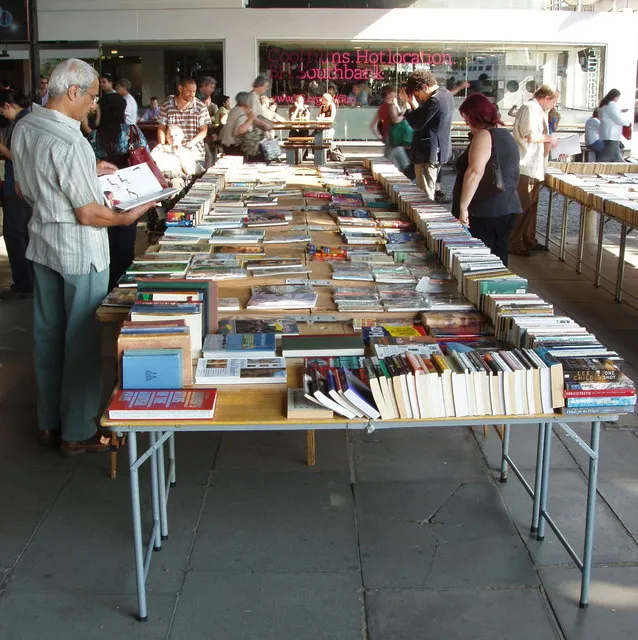
Photo: David Hawgood, CC BY-SA 2.0, via Wikimedia Commons
There is a particular kind of Saturday afternoon that involves drizzle, a carrier bag, and a slow lap of the local charity shops. You go in for a look, maybe a lamp, possibly a jigsaw with three pieces missing. You come out with a Graham Greene paperback, a cookbook you will never use, and the faint smell of old paper on your hands.
The bookcase at the back is always the best bit. It is also, if you stop and look properly, a small archaeological site. Every donated book arrives with a previous life attached: an inscription, a grocery list, a bus ticket from a route that no longer exists. You are not just buying a story. You are buying the evidence of somebody else's reading habits.
The bookcase as a little museum
My local Oxfam has its books arranged with the quiet confidence of a proper shop. The British Heart Foundation down the road is more of a lucky dip, with crime next to gardening and a biography of Churchill wedged under a Jamie Oliver. The hospice shop has handwritten labels and a volunteers' tea rota on the wall. None of them are trying to be a museum, which is exactly why they feel like one.
A new book from a chain shop is anonymous. A second-hand book has form. It has been on a shelf, in a bag, on a bus, and probably under a cup of tea at some point. You can tell a lot about a person from what they leave inside.
A rough taxonomy of things left behind
After a few months of keeping an eye out, the finds tend to fall into groups.
The dedication. Usually on the inside cover, often in blue biro. 'To Mum, Christmas 1994.' 'For Margaret, who always wanted to go to Venice.' 'To Kevin — happy birthday, from someone who clearly panicked in WHSmith.' Some are sweet, some are funny, and a few are so vague you wonder if the giver knew the recipient at all.
The pencilled note. A crossword half-finished, a sentence underlined three times, a margin comment reading 'nonsense' or 'quite right'. One paperback had a list of phone numbers on the last page and the words 'DO NOT LEND TO DAVE' underlined twice. I have thought about Dave a lot since.
The receipt. Tesco, Boots, a garden centre, a petrol station. Usually faded to the colour of weak Tea. Sometimes it tells you the book was bought in 2019 and donated within the same month, which suggests either a very decisive reader or a very efficient clear-out.
The bus ticket. These are the stars. A dead bus ticket is a tiny time machine. One from a route that stopped running years ago, one with a return half still attached, one used as a bookmark at page 84. It does not mean the book is haunted. It means the reader used whatever was in their pocket, which is somehow better.
The proper bookmark. Occasionally you get a real one: a leather strip, a funeral card, a holiday postcard, a photo of somebody's dog. These are the finds that make you pause. You do not want to keep someone's family photo, but you also cannot put it back on the shelf. The usual solution is to hand it to the volunteer and hope they have a system.
What the inscriptions tell you
A dedication is a tiny short story with the middle missing. 'For Dad, from your favourite daughter' — was that a joke? A sincere claim? A provocation at Christmas lunch? You will never know, and that is the point.
Some inscriptions are love letters in disguise. 'To Eileen, because you said you wanted to read more this year.' Some are apologies. 'Sorry about the wine, hope this makes up for it.' Some are just practical. 'To Joan, happy birthday, do not read the ending first.'
Then there are the books with no inscription at all, but a train ticket from Leeds to York and a phone number on page 12. That is not a story, it is a whole evening.
The volunteers know more than they let on
Charity shop volunteers see hundreds of books a week. They develop a sixth sense for the ones that will sell and the ones that will sit there until the next bag of donations arrives. They also develop a diplomatic way of dealing with the oddities.
'The things people use as bookmarks,' one volunteer told me, with the weariness of someone who has found a rasher of bacon in a Danielle Steel. 'We had a slice of ham once. Not dried. Actual ham.'
They are also the best people to ask if you want a recommendation. They know which local author is popular, which crime series disappears fastest, and which cookbook has never been opened. They are not booksellers, but they are close enough.
Why it is worth buying second-hand this winter
This winter, with everything costing more than it should, the charity shop bookcase is a small mercy. Paperbacks are often 50p or a pound. Hardbacks cost less than a coffee. You can take a chance on something you would never buy new, and if you hate it, you can donate it back. The book gets another life, the charity gets a few quid, and your shelf gets a bit more interesting.
There is also the pleasure of the surprise. You might find a 1970s travel guide to a country that has since changed its name. You might find a recipe book with someone else's gravy stains on the Christmas pudding page. You might find a note that says 'for the next reader — enjoy'.
That is the secret life of a charity shop bookcase. It is not really about the books. It is about the people who read them, the buses they caught, the lists they made, and the small, human habit of leaving a bit of yourself between the pages. Buy one this winter. See what falls out.